-
 by Christian Amegbor
- September 18, 2026
Tensions Rise at La Pleasure Beach as Demolition Begins Under Heavy Security
-
By
Christian Amegbor
- October 2, 2026
- in News
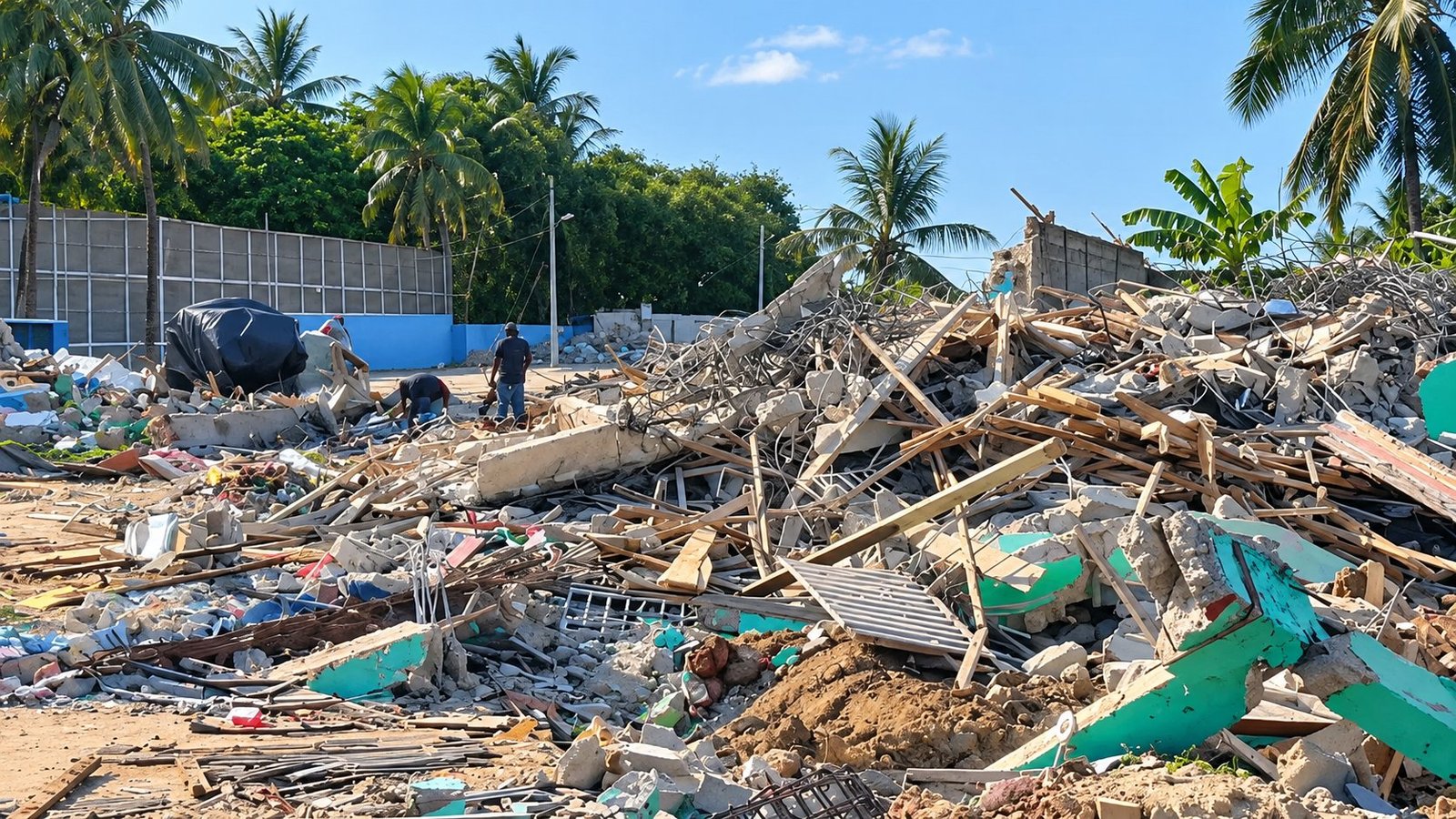
Workers scramble to salvage belongings as soldiers and police oversee demolition amid a long-running dispute over ownership of the prime Accra beachfront
Tension and anger swept through La Pleasure Beach in Accra on Friday as demolition crews moved in under heavy security, pulling down structures at the popular beachfront while workers and operators scrambled to recover their belongings.
The operation began in the early hours of October 2, with personnel from the Ghana Armed Forces’ 48 Engineer Regiment and the Ghana Police Service deployed to the area.
Excavators were seen tearing through structures as security officers restricted access to parts of the site. Workers and other affected individuals searched through damaged buildings and piles of debris, attempting to retrieve equipment, personal possessions and anything else they could save.
The exercise quickly became emotional.
Footage from the scene showed one visibly distressed individual holding eggs while invoking curses against officials and security personnel involved in the operation — a striking expression of the frustration surrounding the demolition.
For those whose businesses and livelihoods were tied to the beachfront, however, the immediate concern was not only the destruction of physical structures, but also what would happen after the demolition crews left.
Early-morning operation catches workers off guard
A worker at the facility told JoyNews that security personnel arrived at about 4:00 a.m. and instructed people at the site to leave.
According to the worker, those present were given only a brief period to remove their possessions before demolition began. He claimed that within about 15 minutes of the evacuation order, excavators had started pulling down structures.
By later in the morning, some buildings had been completely demolished, while others had sustained significant damage.
The security presence limited access to sections of the beachfront as the operation continued. Those allowed into affected areas could be seen trying to recover items from the rubble.
Some workers broke down in tears as they watched structures connected to their livelihoods being destroyed.
For many of them, La Pleasure Beach is more than a leisure destination. The beachfront supports restaurants, entertainment businesses, traders, hospitality workers and other commercial activities that depend on the steady flow of visitors to the area.
Anger and uncertainty at the beachfront
The demolition triggered strong reactions among workers and others affected by the exercise.
One of the most dramatic scenes involved an individual holding eggs and invoking curses against those responsible for the operation. While unusual, the incident captured the anger and sense of helplessness expressed by some people at the site.
Others focused on recovering property before more structures were brought down.
Management of La Pleasure Beach had previously warned that removing businesses from the area could have significant economic consequences.
In September, management claimed that activities at the beach directly employed more than 500 people, while thousands more depended indirectly on economic activity generated around the facility. Those figures were provided by management and have not been independently verified.
The demolition now leaves many of those workers and operators facing uncertainty over their businesses and sources of income.
Long-running land dispute at centre of controversy
Behind Friday's dramatic scenes is a broader and long-running dispute over ownership and control of the beachfront land.
Management of La Pleasure Beach has challenged claims that the disputed land belongs to the state and has also contested assertions linked to the neighbouring Labadi Beach Hotel.
The disagreement intensified in September after management resisted a 24-hour directive to vacate the premises.
According to Citi News, management argued that the ownership dispute was already the subject of court proceedings and maintained that enforcement action should not proceed before the legal issues had been resolved.
Management also appealed to President John Dramani Mahama to intervene.
At the heart of the controversy are competing claims over ownership, occupation and control of valuable beachfront property in one of Accra's most prominent coastal areas.
Those competing claims remain disputed, making it important to distinguish allegations and assertions by the various parties from matters that have been conclusively determined by a court.
Court proceedings raise questions over demolition
The demolition has also renewed debate over whether enforcement action should proceed while aspects of the underlying property dispute remain before the courts.
In September, private legal practitioner and Newsfile host Samson Lardy Anyenini raised concerns over reports of an impending demolition at the La beachfront, arguing that the courts should be allowed to determine the competing claims.
Anyenini referred to legal proceedings involving Labadi Beach Hotel and Polo Beach Club and argued that the circumstances surrounding the disputed properties should not be conflated with a separate demolition exercise at nearby Laboma, which the government had linked to flood-control measures.
Polo Beach Club had also initiated legal action seeking to prevent interference with or demolition of the property pending the determination of the dispute, according to reports at the time.
The existence of those proceedings has placed greater scrutiny on the legal basis for the latest operation and on the authority under which the affected structures are being removed.
It also raises a broader question: what happens when enforcement action intersects with unresolved claims over land and property?
More than a dispute over buildings
La Pleasure Beach, widely associated with the Labadi beachfront, is one of Accra's most recognisable coastal leisure areas. For decades, the wider beachfront has attracted residents, tourists, traders, restaurants, entertainment operators and other businesses.
That history gives the current dispute significance beyond the structures being demolished.
At stake are wider questions about the management of prime coastal land, the protection of existing businesses, future development of Accra's beachfront and the processes authorities follow when property rights are contested.
There is also a human cost.
Behind every demolished structure are workers, business operators and families whose incomes may depend on commercial activity at the beach.
Friday's scenes brought that reality into sharp focus: excavators tearing into buildings, workers picking through rubble and security personnel standing guard as people tried to retrieve what remained of their possessions.
What happens next?
Attention is now likely to turn to the legal and administrative basis for the demolition, as well as the future of the site.
Management and affected operators have previously challenged attempts to remove them from the beachfront, while Friday's operation demonstrates that the authorities have moved ahead with enforcement.
Further court action could follow, particularly if affected parties maintain that their rights have been breached or that existing proceedings should have prevented interference with the properties.
There may also be pressure on the relevant state institutions to explain the precise basis for the demolition, the status of the disputed land and what development, if any, is planned for the cleared area.
For now, however, the most immediate story is unfolding among the rubble.
Businesses have been disrupted, structures have been destroyed, and workers who once earned their livelihoods along the beachfront are confronting an uncertain future.
The image of a distressed individual holding eggs and invoking curses may become one of the defining moments of Friday's operation. But the anger it represented points to something much larger than an emotional confrontation at a demolition site.
At the centre of the La Pleasure Beach controversy are unresolved questions about land, law, state authority, private interests and livelihoods.
And while excavators can clear structures from the beachfront, the legal and ownership disputes surrounding the land are unlikely to disappear with the rubble.
Please Login to comment in the post!

you may also like


-
by Christian Amegbor
- September 18, 2026
Rev. Francis Lawer Sackitey Launches Memoir o...

-
by Christian Amegbor
- September 19, 2026
Global Evangelicals Church Holds Kasoa Zone D...

-
by Christian Amegbor
- September 19, 2026
GES Warns SHSs Against Turning Away Students...

-
by Christian Amegbor
- September 19, 2026